
Choosing between property management vs self management is not simply choosing whether to pay a fee. It is choosing who will run a hospitality business, protect the home, answer guests, coordinate vendors, adjust pricing, keep records, and respond when plans change. If you are considering professional support, Southern Coast Vacation Rentals (SoCo) provides local vacation rental property management in Panama City Beach with property care, owner reporting, revenue strategy, and local coordination. This guide gives you a practical way to compare the options - including the documentation gaps most comparison articles miss.
Key takeaways
- Self-management can work when the owner has flexible time, reliable local coverage, operating discipline, and a documented system for every recurring task.
- A manager's fee should be compared with the full cost of self-management: owner time, software, local vendors, missed revenue, mistakes, and the mental load of remaining available.
- Documentation quality matters in both models. Records should be current, reconcilable, exportable, and accessible to the owner - especially for taxes, inspections, maintenance, claims, and a future handoff.
- Panama City Beach city requirements differ from rules in unincorporated Bay County, so confirm the property's jurisdiction before assigning compliance responsibilities.
The Decision is Bigger than a Management Fee
Self-management offers direct control and removes a percentage-based management expense. Professional management can return time to the owner and provide an established operating system.
Either model can perform well. Either can also create expensive problems when the work is underestimated or the responsibilities are vague.
The better question is not, "Can I manage this property?" It is, "Can this operating model deliver consistent guest service, protect the property, produce clear financial records, and hold up during a busy week, an inspection, a repair, or a change in management?"
Start by comparing 5 outcomes:
- Property protection: Are inspections, repairs, replacements, and preventive tasks identified and closed out with documentation?
- Guest experience: Can someone respond, make decisions, and coordinate help whenever a stay requires attention?
- Revenue performance: Are rates, minimum stays, channel availability, listing quality, and booking pace reviewed often enough?
- Owner visibility: Can the owner understand reservations, revenue, expenses, work orders, and calendar activity without decoding disconnected reports?
- Continuity: Could another qualified person take over the operation without rebuilding it from texts, inboxes, and memory?
That last question is where documentation becomes a decision tool. A well-run property should not depend on one person's memory, whether that person is the owner or a manager.
What Self-Managing a Vacation Rental Actually Requires

Self-management means the owner is the operator. Automation may reduce repetitive work, but it does not remove accountability. The owner still needs to design the system, monitor exceptions, maintain local vendor coverage, and make decisions.
Recurring work commonly includes:
- Creating and updating listings, photographs, amenity details, house rules, and guest instructions
- Setting rates, minimum stays, discounts, blocked dates, and channel availability
- Answering pre-booking questions and communicating before, during, and after each stay
- Coordinating housekeeping, linen processes, inspections, restocking, and same-day turnover issues
- Triaging maintenance, obtaining estimates, approving repairs, and confirming completion
- Monitoring locks, internet, utilities, safety equipment, appliances, and access procedures
- Tracking reservations, platform payouts, refunds, chargebacks, expenses, taxes, and owner use
- Maintaining licenses, registrations, inspection records, association requirements, and required postings
- Responding to complaints, damage, lost items, weather disruptions, and after-hours problems
- Reviewing performance and correcting issues that affect reviews, availability, or revenue
The visible time is only part of the cost. An owner may spend a few minutes replying to a guest, then much longer coordinating a cleaner, documenting a damaged item, moving a future reservation, reconciling a refund, and following up after the repair.
Remote self-management can work, but it is not management without local support. It is management through a local network that the owner recruits, schedules, evaluates, and replaces when needed. Build that network before the first urgent call, not after it.
What a Local Vacation Rental Manager May Handle
Full-service vacation rental management can combine several roles: revenue manager, marketer, guest-service team, housekeeping coordinator, maintenance coordinator, bookkeeper, and local operating contact. Scope varies by company, so be sure to review any management agreements carefully.
A manager may handle:
- Property onboarding, professional photography, listing creation, and channel distribution
- Daily rate optimization, booking rules, promotions, and calendar management
- Guest screening processes, communication, check-in guidance, and issue coordination
- Housekeeping schedules, quality standards, linen processes, and turnover verification
- Maintenance triage, vendor scheduling, owner approvals, and preventive checks
- Owner statements, portal access, calendar visibility, and payout coordination
- Licensing, inspections, and lodging-tax workflows where included and applicable
- Documentation for damage claims, refunds, incidents, and open work orders
- Performance reviews using booking, pricing, conversion, expense, and guest-feedback data
SoCo's owner promise centers on local oversight, transparent reporting, property protection, and data-informed revenue decisions. That is the right standard for evaluating any manager: specific responsibilities, visible follow-through, and records the owner can understand.
Professional management does not remove the owner's role completely. Owners still approve the agreement, define personal-use priorities, maintain appropriate insurance, review statements, authorize larger decisions, and confirm that the manager's actual work matches the contracted scope.
Lorem Ipsum is simply dummy text of the printing and typesetting industry. Lorem Ipsum has been the industry's standard dummy text ever since the 1500s, when an unknown printer took a galley of type and scrambled it to make a type specimen book.
Property Management vs Self Management: A Side-By-Side Comparison
Do not score this table by counting which column has more appealing phrases. Weigh the areas that matter most for your property, ownership goals, distance, risk tolerance, and available time.
How to Compare Self-Management vs a Property Manager for Documentation Gaps
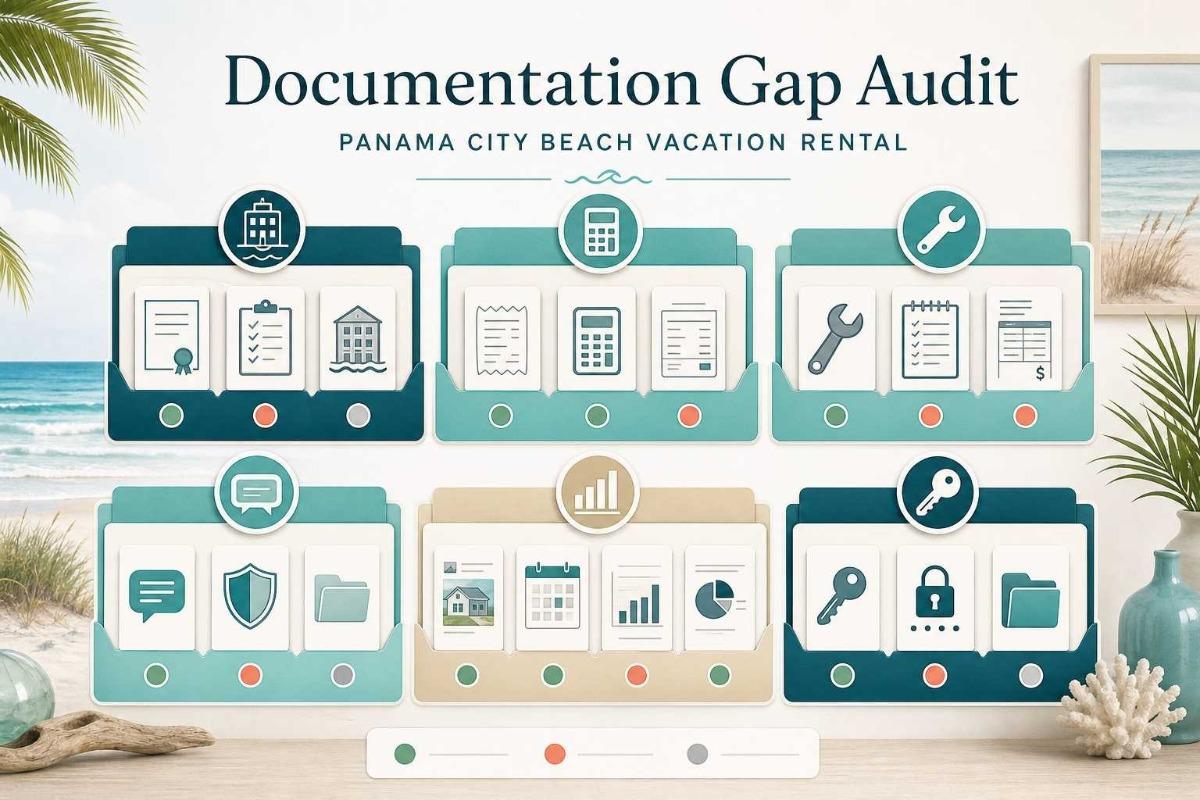
A documentation gap is not only a missing file. A record can exist and still fail when it is outdated, incomplete, impossible to reconcile, stored in a person's private account, or unavailable during a transition.
For each category below, ask five questions:
- Does the record exist?
- Is it current and complete?
- Can it be matched to the reservation, payment, repair, or requirement it supports?
- Can the owner view and export it in a useful format?
- Who owns or controls the account where it is stored?
Licensing, inspection and association records
The compliance file should identify the property's actual jurisdiction before listing requirements. Panama City Beach states that vacation rentals within city limits need a valid Vacation Rental Certificate. Its current registration workflow calls for supporting documents that include a notarized affidavit, a Florida DBPR license, Bay County tourist-development-tax registration, and a city business tax receipt. Annual re-registration, inspections, required contact information, and property postings can also apply. Review the City of Panama City Beach short-term rental page for current details.
Unincorporated Bay County has a separate short-term vacation rental certificate and inspection program. The county currently describes annual requirements for covered one- through four-family structures and notes an exemption for high-rise condominium units and apartment complexes. See the Bay County inspection and registration guidance and confirm the current rule for the property's building type.
Keep copies of applications, licenses, certificate numbers, inspection reports, renewal dates, payment confirmations, required signage, responsible-party information, pool or balcony documents when applicable, and current association rules. Assign one person to monitor dates and another method of verification so a renewal does not depend on memory.
Tax and Financial Records
Financial records should tell one consistent story across booking platforms, direct reservations, deposits, refunds, bank activity, invoices, and owner statements. A monthly close is more useful than a year-end reconstruction.
The Bay County Clerk currently states that its tourist development tax applies within a defined special taxing jurisdiction, that returns are due monthly, and that a return is required even when there is no income to report. It also states that Airbnb, Vrbo, and HomeAway do not remit that county tax for the taxpayer. Check the Bay County Tourist Development Tax guidance before relying on a platform setting.
Maintain tax registrations, filed returns, payment confirmations, platform tax reports, reservation-level revenue, refunds, chargebacks, bank deposits, invoices, receipts, owner payouts, management fees, and personal-use dates. The owner and manager should agree on who files which return, who verifies it, and who retains proof.
Property Condition, Maintenance and Vendor Records

A work order marked "complete" is not always a complete record. A stronger file includes the reported issue, date, photos or inspection notes, temporary action, estimate, owner approval when required, assigned vendor, invoice, completion evidence, warranty information, and follow-up result.
Keep a dated baseline inventory and condition record before the first managed stay or at the start of a new agreement. Then use consistent turnover and preventive-maintenance checks. This helps separate ordinary wear, guest damage, pre-existing conditions, and capital replacement needs.
Vendor records should show current contact details, service scope, pricing or estimate, insurance or licensing information when relevant, invoices, and performance notes. If one vendor becomes unavailable during peak season, the record should help another qualified provider step in.
Guest, Incident and Claim Records
Guest records may include the reservation, signed terms where used, communication history, payment and refund details, registration information required by the property, and notes about accessibility or service needs. Store only what the operation legitimately needs and protect personal information.
For an incident or damage claim, create one file that links the timeline, guest communication, photographs, invoices, refund or claim decision, platform case number, and final resolution. Scattered screenshots make it harder to explain what happened or recover eligible costs.
Document weather, building, or utility disruptions when they affect a stay. Record what was known, when guests were updated, what support was offered, and how the matter was closed. Clear, factual records support both service recovery and later review.
Listing, Pricing and Performance Records
Preserve the current listing description, photographs, amenity selections, house rules, channel links, rate rules, discounts, minimum stays, cancellation settings, and blocked dates. Record material changes and the reason for them.
Performance files should let the owner compare gross booking revenue, realized average daily rate, booked nights, available nights, owner blocks, cancellations, refunds, channel costs, and owner-retained revenue. A dashboard is helpful, but periodic exports protect continuity if software or account access changes.
Account Ownership, Access and Transition Records
Before signing with a manager, ask who owns the listing accounts, domain, direct-booking site, photographs, copy, reviews, guest history, phone numbers, smart-lock account, pricing account, and property-management-system data. Then ask what the owner receives if the agreement ends.
A transition-ready file should include future reservations, guest balances, owner payouts, open refunds, claims, work orders, access codes, keys, vendor contacts, current listings, rate rules, tax filings, licenses, inspection dates, and the final owner statement. Access credentials should be transferred securely, not placed in an ordinary shared document.
Compare Total Economics, Not Just a Manager's Fee
Lorem Ipsum is simply dummy text of the printing and typesetting industry. Lorem Ipsum has been the industry's standard dummy text ever since the 1500s, when an unknown printer took a galley of type and scrambled it to make a type specimen book.
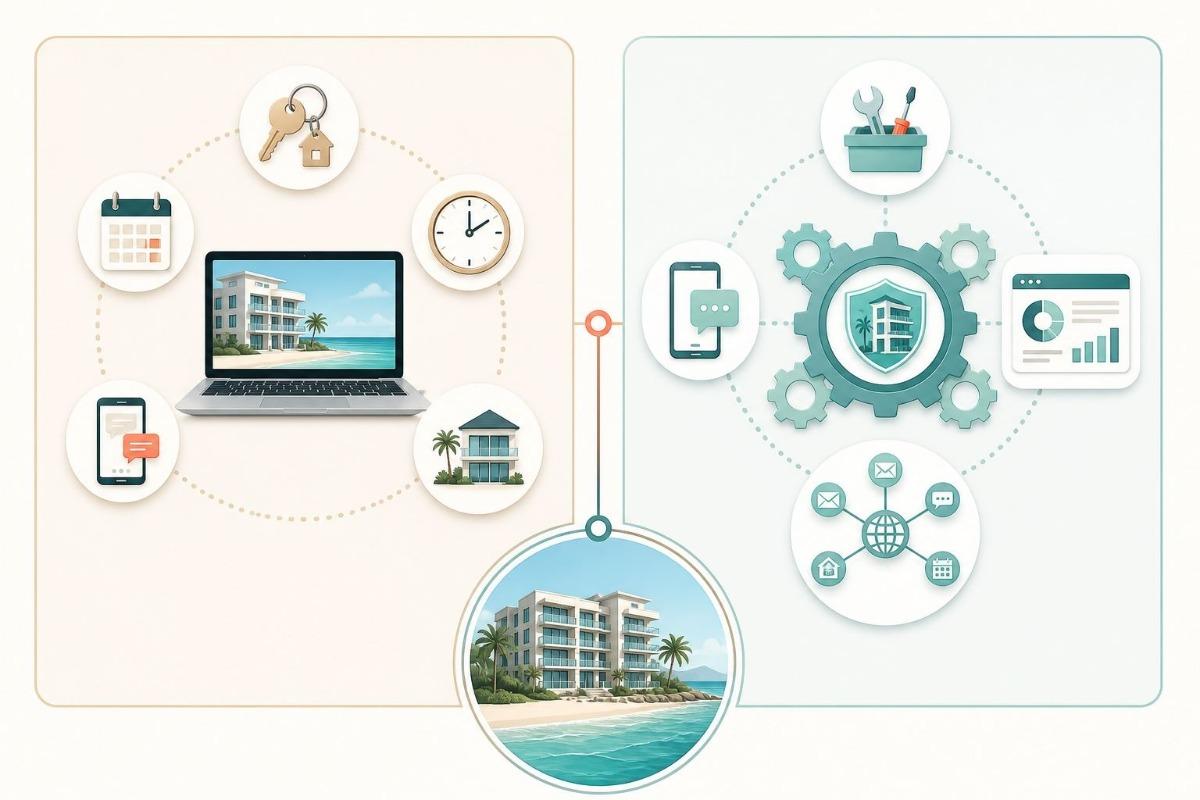
The cost of professional management is visible. The cost of self-management is distributed across time, software, vendors, missed opportunities, and risk.
Build two annual scenarios using the same property and availability assumptions.
Self-managed net before debt service and owner-specific taxes:
Gross rental revenue - platform and payment costs - housekeeping and linen costs - maintenance and supplies - software and marketing - licensing and professional services - other operating costs - value of owner labor
Professionally managed net before debt service and owner-specific taxes:
Projected gross rental revenue under the manager's plan - management fee - separately charged services - owner-paid operating costs
Do not assume gross revenue will be identical under both models. Compare the proposed pricing process, distribution, listing presentation, booking rules, available nights, review performance, and downtime. Also do not assume a manager will automatically outperform. Ask for the evidence and assumptions behind any projection.
Look at a low, base, and high projection. Then test what happens if occupancy softens, a major repair closes dates, owner use removes a peak week, or the manager's additional fees are higher than expected.
To create a property-specific starting point, use the SoCo vacation rental income estimator, then compare the result with your actual self-management costs and time. A projection is an estimate, not a guarantee.
Disadvantages of Hiring a Property Manager
Hiring a manager can solve operational problems, but it also creates a new layer to evaluate. Common disadvantages include:
- Management cost: The fee and separate charges reduce owner-retained revenue. Ask what the percentage applies to and which services cost extra.
- Less direct control: The manager may make routine pricing, guest-service, or vendor decisions within the agreed scope. Owners who want to approve every detail may find the model frustrating.
- Variation in quality: A polished proposal does not prove strong daily execution. Portfolio load, team turnover, local coverage, and operating standards matter.
- Communication lag: Poorly designed approval paths can slow maintenance decisions or leave the owner unsure about status.
- Limited transparency: Some reports show the payout without enough reservation-level or expense detail to reconcile it.
- Account and data dependency: If the manager controls listings, photographs, software, phone numbers, or guest history, a future transition can be difficult.
- Contract constraints: Notice periods, termination terms, future-booking treatment, repair authority, vendor markups, and onboarding or exit charges can affect flexibility.
- Brand distance: An owner who enjoys direct guest relationships may feel removed from the hospitality experience.
These disadvantages are reasons to conduct due diligence, not reasons to reject professional management automatically. A clear agreement, owner access, documented standards, regular reporting, and an exit plan can reduce many of them.
When Self-Management May Be The Better Fit
Self-management may fit when most of these are true:
- You enjoy hospitality and operations rather than viewing them as an interruption.
- Your schedule allows prompt guest and vendor decisions throughout the week.
- You live close enough to respond or have reliable local people with defined roles.
- You can evaluate housekeeping, maintenance, and property condition consistently.
- You understand pricing, booking channels, financial reconciliation, and local operating requirements - or will hire specialists where needed.
- You use written procedures, shared records, backups, and a monthly close.
- The property and guest experience are simple enough for the system you can sustain.
- Keeping direct control is worth the time and responsibility to you.
Run a 30-day workload log before deciding. Record routine time, after-hours interruptions, vendor follow-up, financial work, and the work of checking that tasks were done. That produces a better estimate than relying on memory after a quiet week.
When a Local Rental Manager May Be the Better Fit
A local manager may fit when:
- You live away from Panama City Beach or do not have dependable local coverage.
- You have limited availability for guest messages, turnovers, and urgent decisions.
- The property has high occupancy, frequent turnovers, complex amenities, or meaningful maintenance exposure.
- Pricing, channel distribution, photography, and listing conversion need more consistent attention.
- You want organized reporting, calendar visibility, and coordinated property care without building the entire operating system yourself.
- A second property or growing portfolio has turned hosting into a job you did not intend to create.
- You want a documented path through onboarding, permits, inspections, taxes, and vendor coordination where included.
- The value of your time and reduced disruption supports the total management cost.
Local should mean more than a Panama City Beach address in marketing. Ask who actually handles guest needs, property checks, repair decisions, after-hours coordination, owner questions, and escalation. Then ask how those actions appear in the records you can see.
Can a Hybrid Management Model Work?
Yes. An owner might keep pricing and guest communication while outsourcing housekeeping and maintenance, or keep direct bookings while using a local co-host for in-market support. Hybrid models can preserve control and reduce workload.
They can also create gaps when each side assumes the other is responsible. Put the operating split in writing. For every task, identify:
- The primary owner
- The backup person
- The required response time
- The approval threshold
- The system of record
- The escalation path
- The evidence that closes the task
Pay special attention to refunds, tax filings, inspections, emergency calls, damage claims, listing changes, and future-reservation communication. Those are the places where an informal handoff can become expensive.
A Panama City Beach Documentation Audit Before You Decide
Use this audit for self-management, manager interviews, or a current management relationship. Mark each item complete, needs update, missing, or not applicable.
Property and compliance
- Confirmed city or unincorporated county jurisdiction
- DBPR license and covered rental address
- City or county certificate, inspection records, and renewal dates as applicable
- Business tax receipt and tourist-development-tax registration as applicable
- Current required interior and exterior postings
- Association declaration, rental rules, parking rules, occupancy limits, and contact procedures
- Insurance policy and current agent contact information
Financial and tax
- Reservation-level revenue and payout exports
- Bank deposit reconciliation
- Refund, chargeback, and damage-claim record
- Monthly owner statements or property-level profit-and-loss reports
- Invoices and receipts linked to expenses
- Filed tax returns and payment confirmations
- Personal-use and unavailable-night calendar
Property operations
- Baseline inventory and dated condition photos
- Turnover and quality-control records
- Preventive-maintenance schedule
- Open and completed work orders with invoices and completion proof
- Vendor list, backup providers, and relevant credentials
- Warranties, appliance details, lock records, and utility contacts
- Incident and insurance-claim files
Marketing and access
- Listing-account ownership and administrator access
- Current photo, copy, amenity, house-rule, and guest-guide files
- Rate rules, minimum stays, discounts, and channel settings
- Performance exports and change history
- Secure access plan for locks, software, email, phone, and direct-booking systems
- Written transition process for future reservations, payouts, records, and credentials
If several items are missing, consider making a change.
Questions to ask a vacation rental manager
Ask for specific examples and sample reporting where appropriate:
- Which services are included in the management fee, and which are billed separately?
- Who handles guest communication, property issues, after-hours calls, and owner questions?
- How do you set and review rates, minimum stays, discounts, and blocked dates?
- What does your housekeeping quality-control process document after a turnover?
- How are preventive maintenance, repair approvals, vendor invoices, and completion evidence recorded?
- Which Panama City Beach, Bay County, state, tax, inspection, or association workflows do you coordinate, and which remain the owner's responsibility?
- What can I see in the owner portal, and what reports can I export?
- Can I reconcile each owner-statement amount to reservations, refunds, fees, and invoices?
- Who owns the listing accounts, photographs, descriptions, direct-booking assets, reviews, and guest data?
- How are future reservations, open work orders, claims, payouts, permits, tax records, and account access transferred if the agreement ends?
- What notice, termination, repair-approval, and vendor-markup terms should I understand before signing?
- How will we review the property's performance and update the operating plan?
Clarity builds trust. A strong manager should be able to explain the workflow, not only the outcome they hope to produce.
Frequently asked questions
Is it better to self-manage or hire a property manager?
It depends on the property, the owner's time, local coverage, operating skill, and goals. Self-management can be a strong fit for an owner who enjoys the work and has dependable systems. Professional management can be a better fit when the owner values time, team coverage, local coordination, and an established operating process.
What is the biggest hidden cost of self-management?
The cost is usually spread across owner time, interruptions, software, vendor coordination, slower repairs, pricing mistakes, unavailable nights, and incomplete follow-through. Track the work for a month and assign a realistic value to the owner's time before comparing it with a management fee.
What are the main disadvantages of hiring a property manager?
The main drawbacks are cost, less direct control, uneven service quality, possible reporting or communication gaps, and dependence on manager-controlled accounts or data. Review the agreement, reporting samples, operational standards, account ownership, and transition process before signing.
Can I self-manage a Panama City Beach vacation rental remotely?
Yes, if you build dependable local coverage for housekeeping, inspections, maintenance, access problems, and urgent guest needs. Remote self-management still requires the owner to supervise that network, maintain records, monitor compliance, and make timely decisions.
What documents should a vacation rental property manager provide?
The exact package depends on the agreement, but owners should generally expect clear reservation and financial reporting, payout details, invoices or expense support, maintenance status, calendar visibility, and access to the records needed for tax, insurance, compliance, and transition purposes. Ask what is available continuously and what requires a request.
Does hiring a property manager remove the owner's compliance responsibility?
Not automatically. A manager may coordinate licensing, inspections, taxes, or postings where the agreement includes those services, but the owner should confirm the property's requirements and the written division of responsibility. Verify current rules with the appropriate agencies and qualified professionals.
How often should I audit vacation rental records?
Review operating and financial records monthly, with a broader compliance, access, insurance, and maintenance review at least annually and before any management transition. Correcting a gap while the event is recent is easier than reconstructing it later.
Can I switch from self-management to professional management later?
Yes. A clean handoff is easier when listings, future reservations, guest balances, access, vendors, permits, tax filings, property records, and open issues are already organized. Ask the incoming manager for an onboarding checklist and define who will close each gap.
Choose the Model that Stays Consistent, Even Under Pressure
The right management model is the one you can sustain with consistent standards. Compare the actual work, the full economics, local response capacity, owner visibility, and the quality of the documentation - not only the fee.
If you self-manage, build the operation so another qualified person could understand it. If you hire a manager, choose a partner whose scope, records, access, and follow-through remain clear after the sales conversation. In both cases, verify current city, county, state, association, insurance, and tax requirements for the property.
Southern Coast Vacation Rentals pairs local Panama City Beach oversight with clear owner reporting, coordinated property care, and data-informed revenue strategy. When you are ready to compare the numbers, see what your property could earn with SoCo's vacation rental income estimator. Use the result as a starting point, then compare both operating models with the same information, and see which is a better fit for you.