Managing a vacation rental condo is a unique balancing act. Unlike a standalone house, a condo requires you to manage your individual rental unit while also working within the rules and regulations of the condominium association. While the association takes care of the building and common areas, the day-to-day rental operation falls to you or your property manager.
Effective property management for condos needs to connect these 2 sides of ownership.
A vacation-rental manager can handle much of the heavy-lifting related to unit-level rental operations. But that manager does not replace the condominium association, control the common property, or remove all of the owner’s responsibilities.
For you as the condo owner, the practical questions are:
What does the association handle? What can your vacation rental manager handle? And what still remains with you as the owner?
Those distinctions matter in Florida and particularly in a vacation market such as Panama City Beach, where the rental operation may also need to account for association requirements, state licensing, local registration, taxes, parking procedures, guest registrations, and building-specific rules. If you’d rather not coordinate the rental side alone, talk with Southern Coast Vacation Rentals (SoCo) about managing your Panama City Beach condo. We manage the rental side of your condo while flawlessly navigating its association and building requirements.
Key Takeaways
- Condo management involves three distinct roles. The condominium association manages association-level matters, the vacation rental manager handles the rental operation as agreed, and the condo owner retains important financial, approval, and ownership responsibilities.
- Vacation rental management has to work within the building’s rules and regulations. Pricing, listings, guest communication, housekeeping, inspections, maintenance, parking, registration, and access procedures all need to align with current condo requirements.
- Licensing, taxes, association rules, and local requirements need clearly assigned ownership. In Florida and Panama City Beach, owners should know who handles each registration, filing, renewal, payment, and compliance task rather than assuming everything falls under “full-service management.”
- The value of professional management depends on the owner’s needs. The best comparison considers total cost, workload removed, dependable local coverage, reporting and oversight, existing systems, and how much control the owner wants to retain.
What Does Property Management for a Vacation-Rental Condo Include?
A condo operated as a vacation rental has both building-level requirements and unit-level rental responsibilities. Understanding the difference helps owners evaluate exactly what a vacation-rental property manager is - and is not - being hired to handle.
Condo Association Management is Different from Vacation-Rental Management
A condominium association or its manager handles association-level responsibilities under the governing documents and management arrangement. A vacation rental manager works for the individual condo owner, handling the unit’s rental operation within the rules and procedures that apply to the building.
Those roles can affect each other without being interchangeable. A rental guest may use association-controlled parking, elevators, pools, access points, walkways, or other shared facilities even though the vacation rental manager does not control those areas.
For a detailed breakdown of the association, rental manager, and owner roles, see our guide to who handles what in a vacation-rental condo.
What Does a Vacation-Rental Manager Handle for an Individual Condo?
A vacation rental manager helps an individual owner operate a privately owned condo as short-term lodging. Depending on the management agreement, the work may include:
- Listing and marketing the unit
- Setting and reviewing nightly rates
- Managing reservation calendars
- Communicating with guests
- Preparing arrival information
- Coordinating cleaning between stays
- Inspecting the unit
- Handling or coordinating maintenance
- Monitoring inventory and property condition
- Providing owner statements and reporting
- Applying the building’s guest-facing procedures to each reservation
Southern Coast Vacation Rentals is one example of this unit-level management model in Panama City Beach. For condo rentals, we manage the rental operation while incorporating applicable building requirements into guest communication and arrival planning.
The exact scope should be clear in the management agreement. That is especially important with condos because some parts of the guest experience depend on procedures established outside the individual unit.
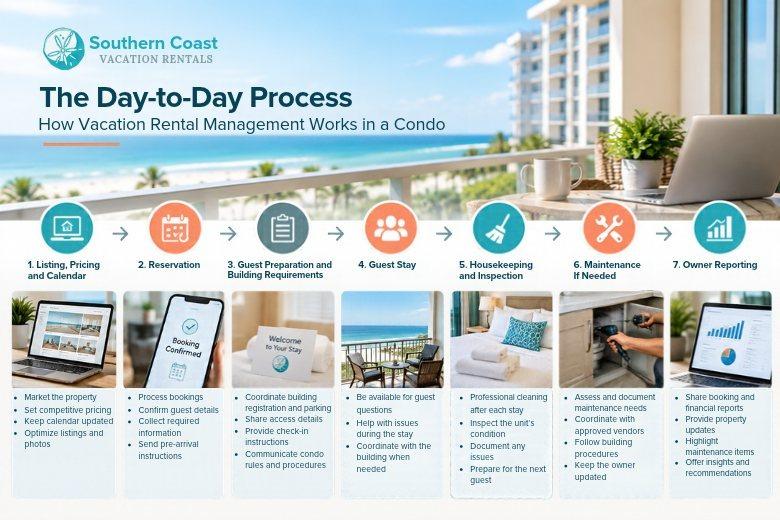
How Should Vacation-Rental Management Work Day to Day in a Condo?
Effective vacation rental management for a condo involves more than reservations and cleaning schedules. The management process also needs to work within the building’s rules, access procedures, physical systems, and guest requirements.
1. Keep the Listing, Pricing, and Calendar Aligned
The listing should correctly describe details such as:
- Occupancy and sleeping arrangements
- Parking, registration, and access procedures
- Resort or association fees guests may pay separately
- Pet restrictions
- Available amenities
- Minimum-stay requirements
- Features of the specific unit
Professional photography and strong listing description are useful, but accuracy matters just as much.
If an association requires a particular minimum rental period, the calendar must be adjusted to not allow for shorter stays. If the building limits vehicles, the listing should not encourage a larger parking expectation. If access to an amenity changes, the published information also needs to change.
Owner use dates, maintenance blocks, minimum stays, existing reservations, and booking channel calendars need to remain synchronized. Dynamic pricing can respond to demand and booking pace, but it still has to operate inside the rules that apply to the property.
2. Manage the Guest Journey Around Building Procedures
A detached vacation home may have one front door and one parking area.
A condo guest may have to navigate several separate systems before reaching the unit.
That can include:
- Parking, vehicle registration, and passes
- Security gates and building entry
- Elevators or front-desk procedures
- Wristbands or amenity registration
- Unit access codes
- Quiet hour and trash procedures
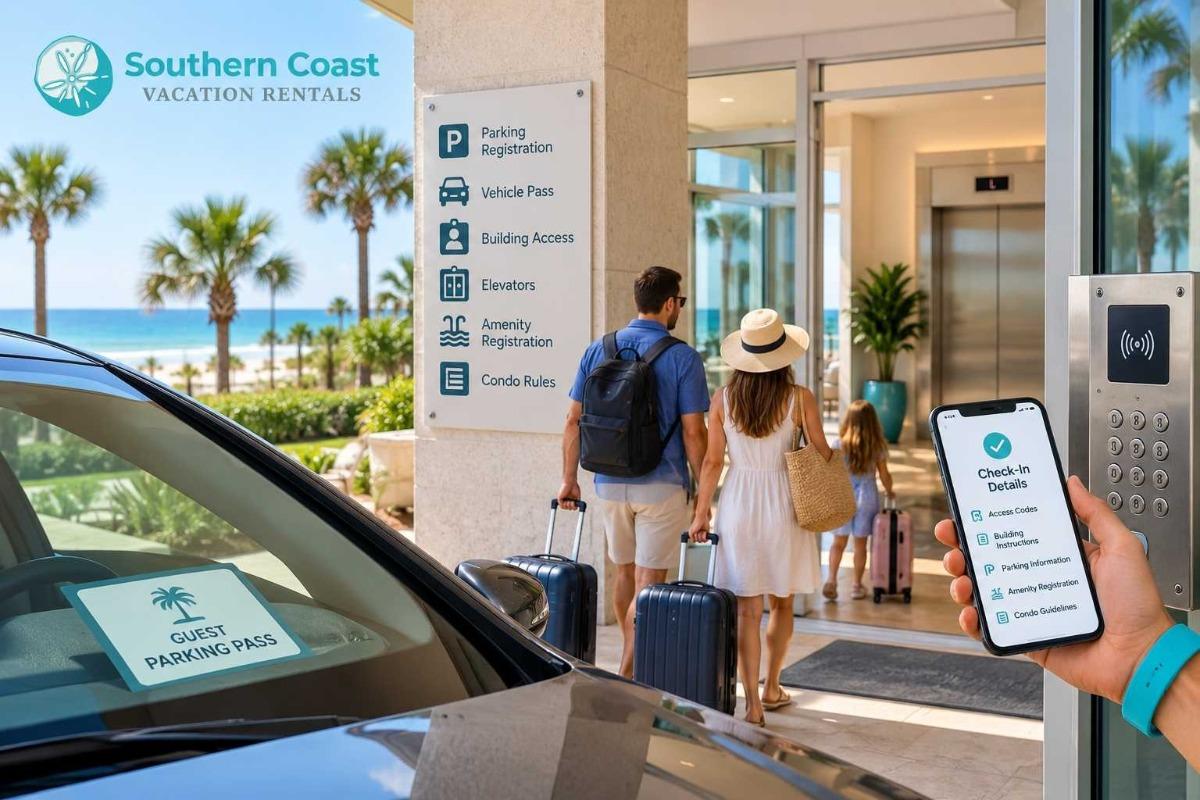
Good condo property management turns those requirements into a logical arrival process.
The guest should know what has to be completed before arrival, what happens on site, what fees are separate from the rental booking, and whom to contact if an access step fails.
If a building requires guest or vehicle information before check-in, the management process should collect it early enough to meet that deadline. Discovering the requirement while the guest is already in the parking lot creates a preventable arrival problem.
3. Coordinate Housekeeping and Turnover Inside a Shared Building
A clean condo is only one part of a successful turnover.
The housekeeping team may also need to work around:
- Building and unit access procedures
- Vendor parking, service entrances, and loading areas
- Elevator use and linen movement
- Same-day departure and arrival timing
- Building restrictions on contractor or vendor access
A written turnover process should make clear what the cleaner handles and what requires a separate inspection or maintenance visit.
The unit itself should be checked for more than visible cleanliness. Depending on the property, a turnover or routine inspection may identify problems such as:
- Missing or damaged inventory and furnishings
- Appliance or HVAC problems
- Plumbing leaks or signs of moisture
- Loose hardware, doors, or lock problems
- Worn linens
- Guest damage
The goal is not to promise that problems will never occur. It is to have a repeatable process for finding them, documenting them, deciding what happens next, and preparing the condo for the next arrival.
4. Protect the Unit Through Inspections and Maintenance
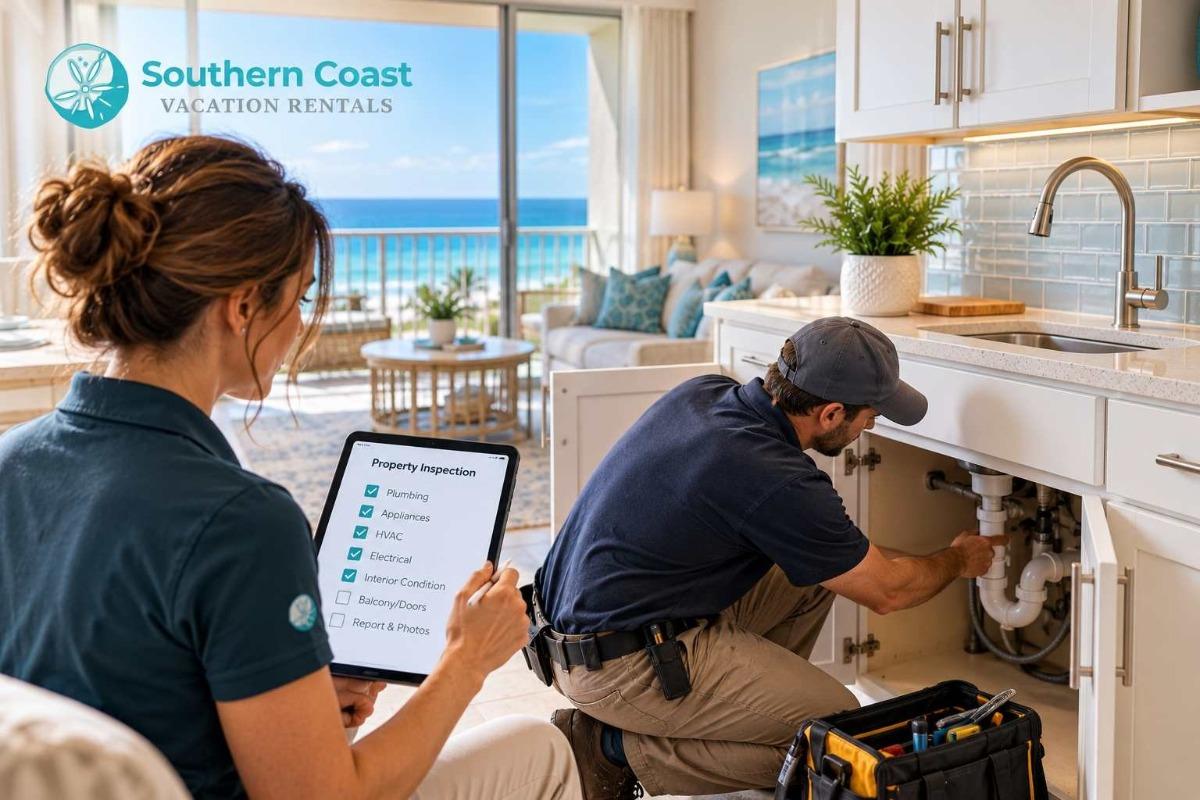
Maintenance can become more complicated in a condominium because the source of a problem is not always inside the rental itself.
A leak discovered inside the condo, for example, could involve:
- A fixture owned by the unit owner
- A neighboring unit
- A building system
- A common or limited common element
- More than one responsible party
The rental manager should not guess at legal responsibility.
Instead, the operating process should make it clear who investigates the problem, whom the manager contacts, when the association or building manager needs to be involved, what work can be authorized immediately, and when owner approval is required.
Owners should establish repair-approval limits in advance.
A manager may need authority to restore an essential service or prevent additional damage without waiting through several rounds of messages. A larger replacement or elective improvement may require the owner’s approval.
That boundary belongs in the management agreement and day-to-day operating process.
5. Keep Owners Informed
Professional management should also give the owner useful visibility into what is happening.
That may include access to:
- The reservation calendar
- Owner statements
- Revenue records
- Maintenance invoices
- Repair documentation
- Property-condition information
- Important changes affecting upcoming stays
Reporting is more useful when the owner can connect a number or charge to the underlying activity.
A maintenance expense should have context. A blocked date should have a reason. A material change affecting future guests should not appear as a surprise after complaints begin.
Florida and Panama City Beach Requirements Still Affect Condo Management
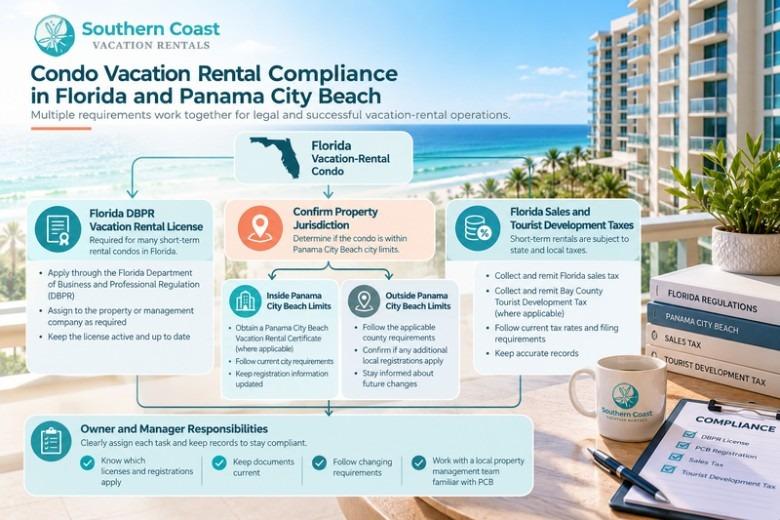
A vacation rental manager operates the unit, but state and local requirements still shape how that rental can operate.
Florida’s Department of Business and Professional Regulation (DBPR) has a specific Vacation Rental - Condo license for a unit or group of units in a condominium or cooperative. According to DBPR’s current Vacation Rental – Condo licensing guidance, owners of new public lodging establishments and new owners of existing establishments must obtain the applicable license before beginning operation.
Local requirements depend on the property’s actual jurisdiction. A Panama City Beach mailing address does not necessarily mean the condo is inside City limits. For properties inside the City, Panama City Beach requires a Vacation Rental Certificate, annual re-registration and reinspection, along with applicable supporting documentation and other property specific requirements. Owners should use the City’s current short-term rental guidance for the applicable registration and renewal checklist.
Taxes add another layer. Florida’s transient rental tax guidance states that the 6% state sales tax, plus any applicable discretionary sales surtax, applies to qualifying rentals of six months or less. Bay County also imposes a 5% Tourist Development Tax on qualifying accommodations within its special taxing jurisdiction.
For professional management, the important question is who handles each applicable registration, renewal, filing, payment, and recordkeeping task. “Handled by management” is too vague when a missed requirement can affect the owner.
For the broader launch and compliance checklist, see our guide to preparing a Panama City Beach condo for short-term rentals.
When Does an Individual Condo Owner Need Professional Management?
An individual owner can choose to self-manage when the property and applicable rules allow it and the owner has the systems to operate it reliably.
Self-management still requires reliable systems for pricing and reservations, guest communication, turnovers, inspections and maintenance, association procedures, compliance workflows, and financial records.
Self-management can work well for an owner who wants hands-on control, has enough time, and has dependable local support.
Professional management becomes more useful when the owner does not want those duties, lives away from the property, lacks dependable local service coverage, or prefers an established management process instead of building one independently.
Evaluating the Cost and Value of Professional Condo Management
Professional management is not automatically worth the fee for every condo owner.
The owner should look at what the service removes from the owner’s workload, what operational capability it adds, what it costs in total, and how much control the owner wants to retain.
1. Consider the Time Commitment
Each reservation can involve pricing, guest communication, arrival preparation, turnover, inspections, maintenance, reviews, and financial reconciliation.
Across a full calendar, those tasks repeat throughout the year.
Owners should compare that time commitment with what they want from the property and how much direct involvement they actually enjoy.
2. Consider Local Coverage
A vacation rental also needs a plan for problems that cannot be solved from a phone.
Examples include:
- A failed door lock or access problem
- An HVAC or plumbing issue
- An incomplete turnover
- A damaged appliance or other in-unit problem
For an owner living elsewhere, reliable local housekeeping, inspection, and maintenance coverage can be a significant part of the management value.
3. Consider the Systems and Local Support You Already Have
An experienced self-managing owner may already have reliable cleaners and maintenance contacts, pricing and booking systems, guest communication processes, inspection procedures, association contacts, and accounting support.
In that situation, professional management would replace work and relationships the owner already has in place rather than building those resources from scratch.
Another owner may have none of those pieces in place.
The same management fee can therefore offer very different value to two owners.
4. Compare Cost and Control Together
Management also means paying for professional services and giving the manager authority over agreed parts of the operation.
Some owners prefer to approve most decisions themselves, while others set clear limits and delegate ordinary operations. The right arrangement is the one that matches the owner’s preferred level of control.
Cost should also be compared beyond the headline commission.
Two managers advertising similar percentages may include different services or charge separately for items such as:
- Linen programs
- Listing setup
- Photography
- Maintenance coordination
- Housekeeping
- Supplies
- Owner-stay cleaning
- Onboarding
- Contract termination
Our guide to vacation rental management fees in Panama City Beach provides a more detailed framework for comparing the percentage, fee base, included services, and separate owner charges.
The lowest percentage is not automatically the least expensive management arrangement.
The better comparison is the total cost, work performed, owner workload, and visibility into the operation.
How to Choose a Property Manager for a Vacation Rental Condo
Generic questions such as “How many properties do you manage?” can provide some context.
Condo owners also need questions that reveal how the company works inside a building controlled partly by another organization.
Here are eight worth asking.

1. How do you obtain and monitor the association rules for my unit?
Ask whether the company requests current documents during onboarding and how later changes reach the operating team.
A rule saved during onboarding is only useful while it remains current.
2. Who handles guest registrations, parking requirements, passes, and deadlines?
Do not stop at “we send arrival instructions.”
Ask:
- Who collects required information?
- Who submits it?
- When is it due?
- How is completion documented?
- What happens when a guest changes vehicles or arrives late?
The answer should describe the process rather than assume guests will work it out at the building.
3. What happens when the association changes a rule or closes an amenity?
Ask the company to explain how it receives the notice, checks affected reservations, updates published information, contacts guests when needed, and informs the owner.
4. How do you handle a problem that may belong to the building rather than the unit?
A manager should have a practical escalation process for problems involving common or shared systems.
The manager’s role is not to determine legal responsibility. It should know when to protect the unit, document the issue, contact the association or building representative, involve the owner, and coordinate access where appropriate.
5. How do your housekeeping and maintenance teams work within building procedures?
Ask how vendors enter the building, where they park, what access they need, and whether there are restrictions that could delay a same-day turnover or repair.
6. Which licensing, inspection, registration, and tax tasks do you handle?
Ask the company to identify which licensing, inspection, registration, tax, renewal, and recordkeeping tasks it handles and which remain with the owner.
Do not assume that “full-service management” means legal responsibility for every filing.
7. What records can I review?
Ask to review examples where appropriate, such as:
- Owner statements and calendar views
- Maintenance records and invoices
- Inspection or turnover reports
8. What happens if I change managers later?
Even a relationship expected to last for years should have a clear exit process.
Confirm:
- Contract term
- Notice requirements
- Termination charges
- Listing ownership
- Photography rights
- Future reservations
- Guest balances
- Open maintenance items
- Records the owner receives
For a broader comparison beyond condo-specific questions, our Panama City Beach property management guide for vacation-rental owners covers service scope, reporting, handoffs, management agreements, and other company-selection factors.
Frequently Asked Questions
What do property management companies do for condos?
For an individual vacation rental condo, a property manager may handle pricing, listings, reservations, guest communication, housekeeping, inspections, maintenance coordination, and owner reporting. The manager also needs to work within the condo association’s rules, access procedures, parking requirements, and other building-specific processes.
Does a condo need a management company?
Not always. An individual owner can self-manage when the property and applicable rules allow it and they have reliable systems for pricing, bookings, guest communication, housekeeping, maintenance, and other operating requirements. Professional management can be more useful when the owner wants less day-to-day involvement or dependable local support.
Is it worth it to use a property management company?
It can be, depending on the owner’s time, location, experience, existing support network, and preferred level of involvement. Compare the total management cost with the work being handled, local coverage provided, reporting and oversight available, and how much control you want to retain.
How Southern Coast Vacation Rentals Approaches Vacation-Rental Condo Management in Panama City Beach
At Southern Coast Vacation Rentals, we are locally operated in Panama City Beach. That local presence matters when work has to happen at the property itself. Condo turnovers, access problems, maintenance issues, inspections, and changing building procedures all require coordination beyond booking software.
Our property management services include:
- Revenue and pricing management
- Professional photography and listing marketing
- Housekeeping
- Property inspections
- 24/7 maintenance support
- Local property support
- Owner access to calendars and statements through an owner portal
We also charge no linen fees or listing fees to owners and require no long-term contracts.
The exact management needs can vary from one condo to another. Association requirements differ by building, so the management agreement should clearly state who handles licensing, registration, tax workflows, maintenance coordination, guest procedures, and owner approvals for that property.
Build a Condo Management Plan Around Clear Responsibilities
Condo vacation rental management works best when all three roles are clear.
The association handles the parts of the condominium under its authority. The vacation rental manager handles the unit-level work assigned through the management agreement. The owner retains the decisions, financial obligations, approvals, and oversight that remain with ownership.
A strong management plan connects those responsibilities rather than leaving gaps between them.
When responsibilities are connected, building requirements can be reflected in the rental operation, property issues can follow a defined escalation path, and owners can see what is happening through documented work and reporting.
For owners considering professional support, talk with Southern Coast Vacation Rentals about your Panama City Beach condo’s property management needs and how day-to-day responsibilities would be handled.