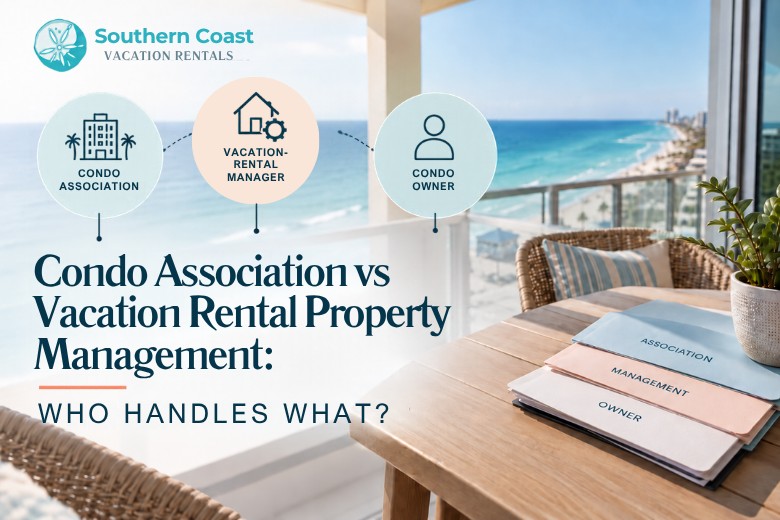
A vacation rental condo operates within two connected systems.
The condominium association handles association-level matters and the portions of the property under its authority. Vacation rental property management focuses on operating an individual owner’s rental, while the condo owner still retains responsibilities that cannot simply be transferred to either one.
These responsibilities often intersect. A guest may stay in a privately owned unit while using association-controlled parking, elevators, pools, walkways, gates, and other shared facilities. A maintenance issue discovered inside the condo may originate in the unit, elsewhere in the building, or in a shared system. A new association procedure may also affect reservations already on the calendar.
The condo association vs. property management distinction largely comes down to who each service represents and which responsibilities it handles. In this guide, property management refers specifically to the management of an individual condo used as a vacation rental.
The useful question, then, is not simply “Who manages the condo?”
It is:
What does the association handle, what can the vacation rental property manager handle, and what remains the responsibility of the owner?
If you own a Panama City Beach condo and want clearer boundaries between what the association handles, what management can handle, and what remains with you, talk with Southern Coast Vacation Rentals about the rental management side of your property.
Key Takeaways
- Condo association management and vacation rental property management are different services. The association manager works for the association under the board’s direction, while the vacation rental property manager works for the individual unit owner.
- The two roles still have to connect operationally. Association rules and building procedures can affect parking, registration, access, amenities, maintenance, and booked stays.
- The condo owner retains important responsibilities. Ownership decisions, financial obligations, approvals, association duties, and management oversight do not disappear when a rental manager is hired.
- The governing documents and management agreement matter. Responsibility can vary by building, unit, issue, and contractual arrangement.
Condo Association vs Property Management: What’s the Difference?
The two types of management may operate within the same condominium, but they serve different clients and handle different responsibilities.
What Does Condo Association Management Handle?
Condo association management serves the association rather than an individual vacation rental owner.
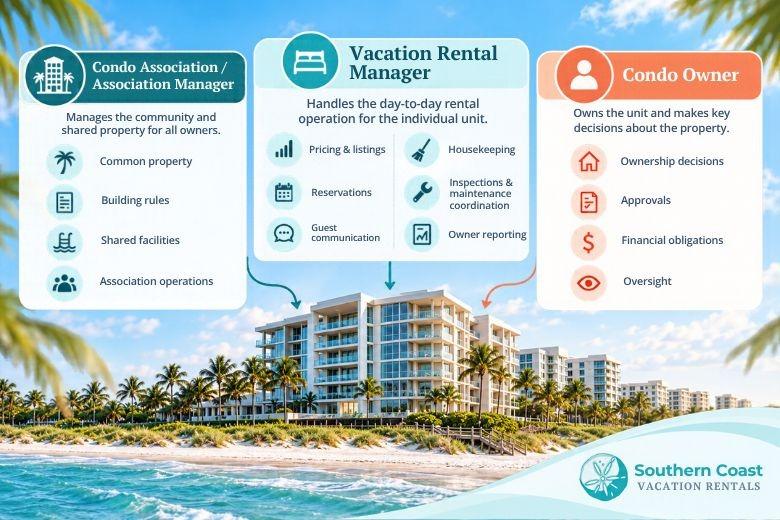
In a Florida condominium, the role may include helping the association handle common property, finances, records, meetings, vendors, maintenance, and other association-level operations, depending on the governing documents and management arrangement.
That distinction matters to vacation rental owners because association decisions and building procedures can still affect the individual rental. Parking rules, common-area access, building maintenance, registration requirements, and other association policies may shape how guests use the property even though the association manager is not managing the owner’s vacation rental.
Depending on the association and its governing documents, this can involve matters such as:
- Common property and shared facilities
- Association finances and records
- Vendor and maintenance coordination
- Building projects
- Rules and policies
- Association meetings
Florida also regulates professional community association management. The Florida Department of Business and Professional Regulation’s guidance for community association managers explains that this work can include controlling or disbursing association funds, preparing budgets or financial documents, assisting with association meetings, coordinating maintenance, and handling other day-to-day association operations.
What Does Vacation Rental Property Management Handle?
Vacation rental property management serves the individual condo owner rather than the association.
Depending on the management agreement, the manager may handle unit-level operations such as pricing and listings, reservations, guest communication, housekeeping, inspections, maintenance coordination, and owner reporting.
The manager also needs accurate building information because guests may use association-controlled parking, elevators, gates, amenities, access points, and other shared facilities.
For the full unit-level operating side, see our property management for condos guide.
Who Handles What in a Vacation Rental Condo?
The exact allocation depends on the association documents and the owner’s management agreement, but this framework helps separate the three roles.
Sources: Florida Condominium Act (Chapter 718, Florida Statutes) and Florida DBPR community association manager guidance.
These are practical starting points, not universal assignments. The condominium declaration, bylaws, association rules, management agreement, insurance policies, and the facts of a particular issue can all affect who is responsible. Owners should therefore rely on the current documents for their own unit rather than a generic responsibility list.
How Association Rules Affect Vacation Rental Property Management
One of the biggest differences between managing a condo and managing a detached vacation home is that the owner does not control every rule affecting the stay.
Before accepting reservations, the owner or manager should obtain the current written rules applicable to the unit.
Those rules may address:
- Whether short-term rentals are permitted
- Minimum rental periods
- Rental-frequency limits
- Approved occupancy
- Minimum guest age
- Guest registration
- Vehicle limits
- Parking
- Pets
- Amenity access
- Wristbands or passes
- Quiet hours
A neighboring unit being used as a short-term rental does not prove that another owner can use the same rental pattern.
Likewise, a previous owner’s operating history does not establish the current rules for a new owner.
Our guide to preparing a Panama City Beach condo for short-term rentals explains what owners should verify before launch, including minimum stays, guest registration, parking, occupancy, pets, and other building procedures.
The same information needs to remain current after launch.
What Happens When an Association Rule Changes?
Association rules and building conditions do not necessarily stay the same throughout the life of a listing.
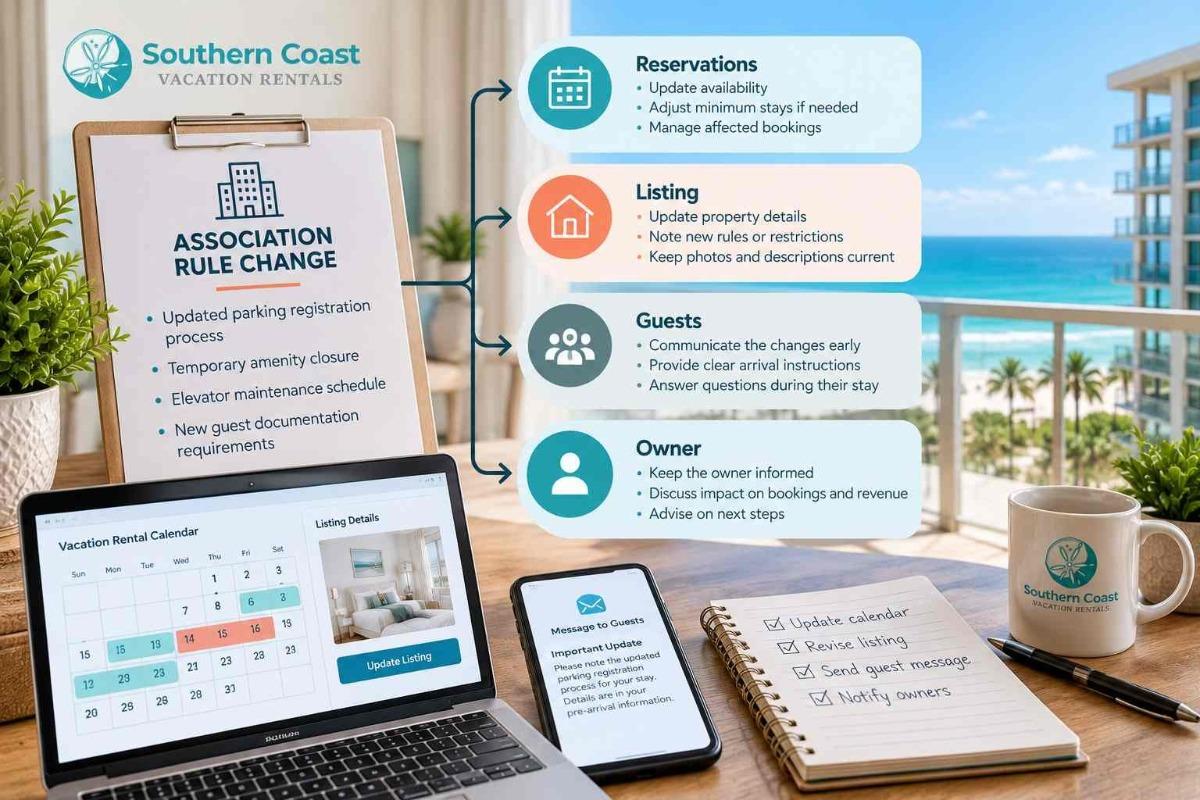
The owner or manager may receive notice of:
- Parking or registration changes
- Construction or elevator projects
- Temporary amenity closures or maintenance
- Changes in building access
- Revised pet or guest-documentation requirements
Not every change has the same legal effect. Operational procedures such as parking or registration can affect upcoming stays immediately, while a new restriction on an owner’s rental rights requires closer review.
Florida Statute §718.110(13) provides that an amendment prohibiting rentals, changing the duration of rental terms, or limiting how often units may be rented applies only to owners who consent to the amendment and owners who acquire title after its effective date. Because the effect of a particular change can depend on the governing documents, the amendment itself, and when the owner acquired the unit, owners should obtain appropriate guidance when their rental rights may be affected.
The important management question is not simply, “Did someone receive the notice?”
The operating process needs to answer four more questions.
1. Which future reservations are affected?
A closure next month may have no effect on today’s guests, but could materially change what has been promised to guests arriving later.
2. Does the listing need to change?
If a published amenity, access procedure, fee, or parking arrangement is no longer accurate, leaving the old information online creates another problem.
3. Which guests need to be contacted?
Not every building announcement belongs in every guest message. Material changes affecting a booked stay do.
4. What does the owner need to know?
A construction project or recurring access issue can affect guest experience, reviews, pricing decisions, maintenance access, or the owner’s personal-use plans.
This is where condo rental management becomes more than answering messages. Someone has to connect information coming from the building with the reservations already on the calendar.
What Still Remains the Responsibility of the Condo Owner?
Professional rental management can remove a large amount of recurring work from an owner’s schedule, but it does not transfer every ownership responsibility.
The management agreement should make clear which day-to-day decisions the manager can make, which require owner approval, and which obligations remain directly with the owner.
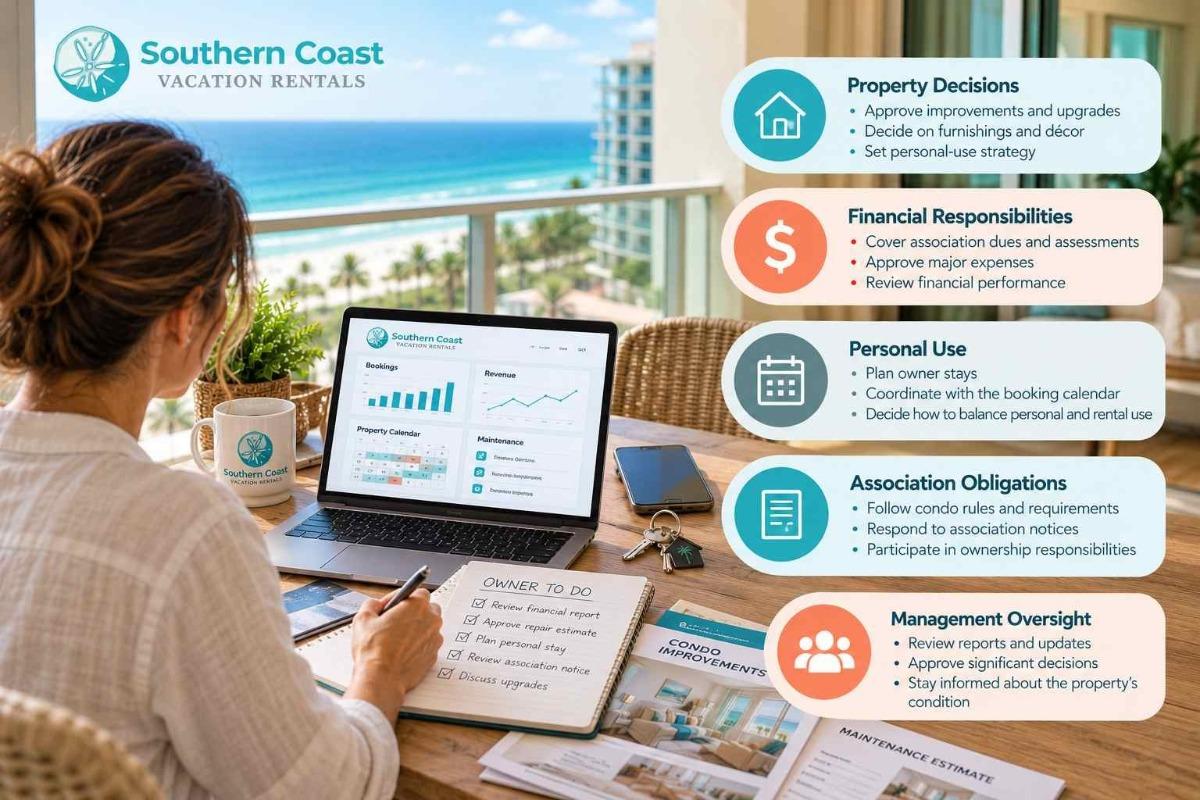
1. Property Decisions
The owner still retains decision-making responsibility for matters such as:
- Furnishings and property upgrades
- Renovations and capital improvements
- Major appliance replacements and larger repairs
Some improvements may also require association approval before work begins.
2. Financial Decisions
Management does not replace the owner’s responsibility to understand the property’s finances.
Owners still need a process for:
- Reviewing statements and operating performance
- Approving larger expenses
- Paying association dues and planning for assessments
- Maintaining insurance
- Budgeting for repairs and replacements
- Reviewing management costs
Agreeing on a repair threshold makes daily operations easier.
For example, the manager may be allowed to authorize urgent work below an agreed amount, while more expensive non-emergency repairs require owner approval.
3. Rental Strategy and Personal Use
Owners also need to decide how the property fits their own plans.
That can include:
- Personal-use dates and extended owner stays
- Renovation or planned-improvement periods
- Major pricing objectives
Blocking owner dates is straightforward when done early.
It becomes more difficult once confirmed reservations already exist, so owners should understand how personal-use dates are entered and protected across booking channels.
4. Association Obligations
A vacation rental manager may help communicate association rules to guests and apply them within the rental operation, but the owner remains a member of the condominium association.
The owner’s association-related responsibilities can include:
- Dues and assessments
- Association voting and notices
- Insurance and governing-document requirements
- Approval processes for work inside the unit
A rental-management agreement should not be treated as a substitute for understanding those obligations.
5. Management Oversight
Owners should also monitor the management relationship itself.
Review:
- Property-condition and repair records
- Revenue statements and owner charges
- Guest-related damage
- Calendar performance
- Material operating changes
Professional management can reduce the amount of daily work an owner performs.
Delegating day-to-day operations should not mean giving up oversight.
Does a Condo Association Have to Hire a Management Company?
The Florida DBPR condominium guidance states that condominium statutes do not require an association to hire a management company.
Whether the board or unit owners must approve the decision depends on the association’s articles of incorporation and bylaws.
If the board employs a manager, that manager must hold the applicable licensure required under Chapter 468, Florida Statutes.
That is an association-level decision and is separate from an individual owner's decision to hire a vacation rental property manager for one unit.
Frequently Asked Questions
What should a property management company do for an HOA?
For a condo association, a management company may help administer finances, records, meetings, vendors, maintenance, and association rules under the board’s direction and management agreement. This is association-level management and is different from managing an individual owner’s vacation rental.
What does a vacation rental property manager handle?
A vacation rental manager works for an individual condo owner and may handle pricing, listings, reservations, guest communication, housekeeping, inspections, maintenance coordination, and owner reporting under the management agreement.
Who handles repairs in a condo?
It depends on the source of the problem, the governing documents, applicable insurance provisions, and the management agreement. A problem found inside the unit may involve owner property, another unit, a common or limited common element, or a building system. The rental manager may document and coordinate the issue without being the party that determines legal responsibility.
Who handles guest parking and registration?
The association, resort, or applicable building administration generally establishes the requirements. A vacation rental manager may communicate those requirements and handle rental-side steps when that work is included in the management agreement. The owner should make sure the process is covered if it has not been delegated.
Does a florida condo association need a management company?
Not automatically. Florida condominium statutes do not require every association to hire an outside management company. The association’s governing documents affect how the decision is made, and applicable licensing requirements apply when professional community association management is used.
Keep Condo Association and Property Management Responsibilities Clear
Operating a vacation rental condo involves more than one layer of responsibility.
When a question comes up, start by identifying whether it concerns the building, the rental operation, or an ownership decision. Then use the governing documents and management agreement to determine who has authority, who needs to act, and who needs to be informed.
Clear handoffs become especially important when one issue crosses those boundaries, such as a building closure affecting booked guests or a maintenance problem involving both the unit and shared property.
For a deeper look at the unit-level operation—from pricing and guest communication to housekeeping, inspections, maintenance, reporting, costs, and manager selection—see our property management for condos guide.
If you want to clarify how those responsibilities would work for your own Panama City Beach condo, talk with Southern Coast Vacation Rentals about the rental management side of your property.